Accelerometer

From SensorWiki

Sensors Interfaces Communications Tutorials References


Table of contents

Summary

Introduction

One of the most common inertial sensors is the accelerometer, a dynamic sensor capable of a vast range of sensing. Accelerometers are available that can measure acceleration in one, two, or three orthogonal axes. They are typically used in one of three modes:

  • As an intertial measurement of velocity and position;
  • As a sensor of inclination, tilt, or orientation in 2 or 3 dimensions, as referenced from the acceleration of gravity (1 g = 9.8m/s2);
  • As a vibration or impact (shock) sensor.

There are considerable advantages to using an analog accelerometer as opposed to an inclinometer such as a liquid tilt sensor – inclinometers tend to output binary information (indicating a state of on or off), thus it is only possible to detect when the tilt has exceeded some thresholding angle.

Types of Accelerometer

There are several different principles upon which an analog accelerometer can be built. Two very common types utilize capacitive sensing and the piezoelectric effect.

Capacitive

Accelerometers that implement capacitive sensing output a voltage dependent on the distance between two planar surfaces. One or both of these "plates" are charged with an electrical current. Changing the gap between the plates changes the electrical capacity of the system, which can be measured as a voltage output. This method of sensing is known for its high accuracy and stability.

Piezoelectric

Piezoelectric sensing of acceleration is natural, as acceleration is directly proportional to force. When certain types of crystal are compressed, charges of opposite polarity accumulate on opposite sides of the crystal. This is known as the piezoelectric effect. In a piezoelectric accelerometer, charge accumulates on the crystal and is translated and amplified into either an output current or voltage.

Piezoelectric accelerometers only respond to AC phenomenon such as vibration or shock. They have a wide dynamic range, but can be expensive depending on their quality (Doescher 1000)

Piezo-film based accelerometers are best used to measure AC phenomenon such as vibration or shock, rather than DC phenomenon such as the acceleration of gravity. They are inexpensive, and respond to other phenomenon such as temperature, sound, and pressure (Doescher 200)

Other

There are many other types of accelerometer that are less important to musical applications, including:

  • Piezoresistive
  • Thermal
  • Null-balance
  • Servo force balance
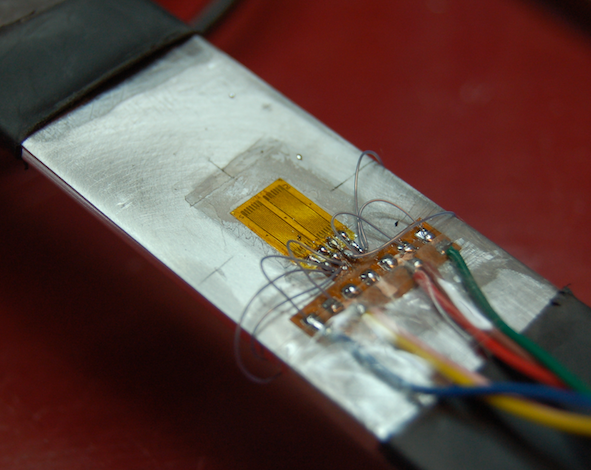
  • Strain gauge
  • Resonance
  • Magnetic induction
  • Optical
  • Surface acoustic wave (SAW)

Specifications

A typical accelerometer has the following basic specifications:

  • Analog/digital
  • Number of axes
  • Output range (maximum swing)
  • Sensitivity (voltage output per g)
  • Bandwidth
  • Amplitude stability

Analog vs. digital: The most important specification of an accelerometer for a given application is its type of output. Analog accelerometers output a constant variable voltage depending on the amount of acceleration applied. Digital accelerometers output a variable frequency square wave, a method known as pulse-width modulation. A pulse width modulated accelerometer takes readings at a fixed rate, typically 1000 Hz (though this may be user-configurable based on the IC selected). The value of the acceleration is proportional to the pulse width (or duty cycle) of the PWM signal.

For use with ADCs commonly used for music interaction systems, analog accelerometers are usually preferred.

Number of axes: Accelerometers are available that measure in one, two, or three dimensions. The most familiar type of accelerometer measures across two axes. However, three-axis accelerometers are increasingly common and inexpensive.

Output range: To measure the acceleration of gravity for use as a tilt sensor, an output range of ±1.5 g is sufficient. For use as an impact sensor, one of the most common musical applications, ±5 g or more is desired.

Sensitivity: An indicator of the amount of change in output signal for a given change in acceleration. A sensitive accelerometer will be more precise and probably more accurate.

Bandwidth: The bandwidth of a sensor is usually measured in Hertz and indicates how often a reliable reading can be taken. For tilt sensing, a bandwidth of 40-60 Hz is adequate. For vibration measurement or accurate reading of impact forces, bandwidth should be in the range of hundreds of Hertz.

Amplitude stability: This is not a specification in itself, but a description of several. Amplitude stability describes a sensor's change in sensitivity depending on its application, for instance over varying temperature or time (see below).

Other specifications include:

  • Zero g offset (voltage output at 0 g)
  • Noise (sensor minimum resolution)
  • Temperature range
  • Bias drift with temperature (effect of temperature on voltage output at 0 g)
  • Sensitivity drift with temperature (effect of temperature on voltage output per g)
  • Power consumption

Output

An accelerometer output value is a scalar corresponding to the magnitude of the acceleration vector. The most common acceleration, and one that we are constantly exposed to, is the acceleration that is a result of the earth's gravitational pull. This is a common reference value from which all other accelerations are measured (known as g, which is ~9.8m/s^2).

Digital output

Accelerometers with PWM output can be used in two different ways. For most accurate results, the PWM signal can be input directly to a microcontroller where the duty cycle is read in firmware and translated into a scaled acceleration value. (Check with the datasheet to obtain the scaling factor and required output impedance.) When a microcontroller with PWM input is not available, or when other means of digitizing the signal are being used, a simple RC reconstruction filter can be used to obtain an analog voltage proportional to the acceleration. At rest (50% duty-cycle) the output voltage will represent no acceleration, higher voltage values (resulting from a higher duty cycle) will represent positive acceleration, and lower values (<50% duty cycle) indicate negative acceleration. These voltages can then be scaled and used as one might the output voltage of an analog output accelerometer.

Analog output

When compared to most other industrial sensors, analog accelerometers require little conditioning. Typically, an accelerometer output signal will need an offset, amplification, and filtration. For analog voltage output accelerometers, the signal can be a positive or negative voltage, depending on the direction of the acceleration. As with any sensor destined for an analog to digital converter, the value must be scaled and/or amplified to maximally span the range of acquisition. Most analog to digital converters usied in musical applications acquire signals in the 0-5 V range.

The image at right depicts an amplification and offset circuit, including the on-board operational amplifier in the adxl 105, minimizing the need for additional IC components. The gain applied to the output is set by the ratio R2/R1. The offset is controlled by biasing the voltage with variable resistor R4. Accelerometers output bias will drift according to ambient temperature. The sensors are calibrated for operation at a specific temperature, typically room temperature. However, in most short duration indoor applications the offset is relatively constant and stable, and thus does not need adjustment. If the sensor is intended to be used in multiple environments with differing ambient temperatures, the bias function should be sufficient for analog calibration of the device. If the ambient temperature is subject to drastic changes over the course of a single usage, the temperature output should be summed into the bias circuit. Smart sensors may even take this into consideration.

The resolution of the data acquired is ultimately determined by the analog to digital converter. It is possible, however, that the noise floor is above the minimum resolution of the converter, reducing the resolution of your system. Assuming that the noise is equally distributed across all frequencies, it is possible to to filter the signal to only include frequencies within the range of operation. The filter required depends upon both the type of acquistion as well as the location of the sensor. The bandwidth is primarily influenced by the three different modes of operation of the sensor.

Uses

The acceleration measurement has a variety of uses. The sensor can be implemented in a system that detects velocity, position, shock, vibration, or the acceleration of gravity to determine orientation (Doscher

A system consisting of two orthogonal sensors is capable of sensing pitch and roll. This is useful in capturing head movements. A third orthogonal sensor can be added to the network to obtain orientation in three dimensional space. This is appropriate for the detection of pen angles, etc. The sensing capabilities of this network can be furthered to six degrees of spatial measurement freedom by the addition of three orthogonal gyroscopes.

As a shock detector, an accelerometer is looking for changes in acceleration. This jerk is sensed as an overdamped vibration.

Verplaetse has outlined the bandwidths associated with various implementations of accelerometers as an input device. These are:

Location Usage Frequency Acceleration
Head Tilt 0-8 Hz xx
Hand , Wrist, Finger Cont. 8-12 Hz 0.04-1.0 g
Hand, Arm, Upper Body Cont. 0-12 Hz 0.5-9.0 g
Foot, Leg Cont. 0-12 Hz 0.2-6.6 g

Depending on the sensitivity and dynamic range required, the cost of an accelerometer can grow to thousands of dollars. Nonetheless, highly accurate inexpensive sensors are available.


IDMIL Projects

McGill student projects utilizing accelerometers:

Devices

Source Country Price
Digikey (http://www.digikey.ca/) Canada

Analog Devices ADXL105

High Accuracy +/- 1 g to +/- 5 g Single Axis Accelerometer with Analog Output

Variants:
Datasheet: [1] (http://pdf.alldatasheet.co.kr/datasheet-pdf/view/48918/AD/ADXL105.html)
Resources:
Notes:


Source Country Price
Digikey (http://ca.digikey.com/) Canada CAN$ 22.05

Analog Devices ADXL202

Low-cost, +/- 2 g, dual-axis accelerometer with duty cycle output

Variants:
Datasheet: [2] (http://www.analog.com/UploadedFiles/Data_Sheets/53728567227477ADXL202E_a.pdf)
Resources:
Notes: This accelerometer is available in a several IC formats.


Source Country Price
Digikey (http://ca.digikey.com) Canada CAN$ 28.41

Analog Devices ADXL203

High-precision, +/- 1.5 g, dual-axis accelerometer with signal conditioned voltage outputs.

Variants:
Datasheet: [3] (http://www.analog.com/UploadedFiles/Data_Sheets/279349530ADXL103_203_0.pdf)
Resources:
Notes:


Source Country Price
Digikey (http://ca.digikey.com/) Canada

Measurement Specialties ACH-04-08-05

3-axis accelerometer, +/- 250 g, three-channel analog output

Variants:
Datasheet: [4] (http://rocky.digikey.com/WebLib/Measurement%20Specialties%20Inc/Web%20Data/0-1003800-5.pdf)
Resources:
Notes:


Source Country Price
Digikey (http://ca.digikey.com/) Canada CAN$ 9.75

STMicroelectronics LIS3L02AS4

3-axis accelerometer, +/- 2 or 6 g, three-channel analog output

Variants: LIS3L02AS5
Datasheet: [5] (http://www.st.com/stonline/books/pdf/docs/10221.pdf)
Resources:
Notes: SO24 surface-mount package


Media

Images
An analog accelerometer on a protoboard with conditioning circuit
Enlarge
An analog accelerometer on a protoboard with conditioning circuit
Video
accel.AVI (https://borges/idmil-resources/sensors/accelerometer/movies/accel.AVI)
MVI_0031.AVI (https://borges/idmil-resources/sensors/accelerometer/movies/MVI_0031.AVI)
Circuits
accel2.eps
accel2.wmf
accelerometer.CKT
accelerometer.eps

External Links & References


Sensors Interfaces Communications Tutorials References