Flexion

From SensorWiki

Sensors Interfaces Communications Tutorials References
Table of contents

Summary

Introduction

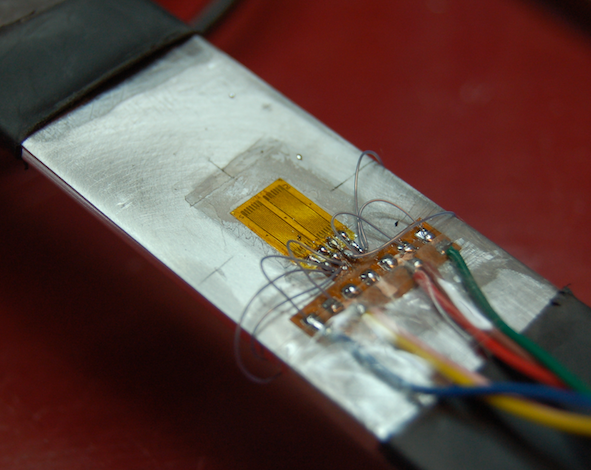
Flexion sensors, also called bend sensors, measure the amount of deflection caused by bending the sensor. They are typically fabricated by laying a strip of resistive ink on a flexible plastic substrate. At rest (when laid flat), the bend sensor is characterized by an intrinsic resistance. This resistance increases as the deflection increases in one direction, and is unchanged if bent in the other direction. Thus this kind of flexion sensor is a unipolar device. As the sensor is bent, the resistive materials inside it are pulled further apart. Fewer adjacent resistive particles come into contact, thereby increasing the resistance. Typically, the resistance at full deflection is about ten times that of a flat sensor. The resistance can be converted into a voltage as described here (https://borges.mt.lan:443/wiki/index.php/Basic_Sensor_Interfacing_Techniques).

A property of the bend sensors worth noting is that bending the sensor at one point to a prescribed angle is not the most effective use of the sensor. As well, bending the sensor at one point to more than 90˚ may permanently damage the sensor. Instead, bend the sensor around a radius of curvature. The smaller the radius of curvature and the more the whole length of the sensor is involved in the deflection, the greater the resistance will be (which will be much greater than the resistance achieved if the sensor is fixed at one end and bent sharply to 90˚).

Placing two devices back-to-back will allow bipolar measurements for capturing deflections in both directions.

Flexpoint Sensor Systems Inc. (http://www.flexpoint.com) makes the Bend Sensor® in 1", 2", and 3" lengths. As you increase in length, the intrinsic resistance goes up, as does the resistance for each sensor at full deflection. They are available with connectors that can be interfaced with standard sized headers. As well, there are different lamination and coating options to increase durability and stiffness. For mechanical and electrical design guides, refer to these links: mechanical specs (http://www.flexpoint.com/mechanical%20design%20guide.pdf) and electronic specs (http://www.flexpoint.com/electronic%20design%20guide.pdf). Hysteresis and noise in resistance value are small if not entirely negligible.

Devices

Jameco sells a flex sensor measuring 4.5" with a 10 KΩ (flat) to 30-40 KΩ (full deflection) range. Ordering guide (http://www.jameco.com/webapp/wcs/stores/servlet/ProductDisplay?langId=-1&storeId=10001&catalogId=10001&productId=150551).

Source Country Price
Flexpoint (http://www.flexpoint.com) USA US$12.95

Flexpoint BendSensor

'

Variants: Available varying lengths and coatings, with or without connectors
Datasheet:
Resources: Electrical Guide (http://www.flexpoint.com/technicalDataSheets/electronicDesignGuide.pdf), Mechanical Guide (http://www.flexpoint.com/technicalDataSheets/mechanicalDesignGuide.pdf)
Notes:


Source Country Price
Jameco (http://www.jameco.com) USA US$ 12.95

FLX-01

Flex Sensor

Variants:
Datasheet: [1] (http://www.jameco.com/wcsstore/Jameco/Products/ProdDS/150551.PDF) (pdf)
Resources:
Notes: resistance: 10 KΩ (0°); 30-40 KΩ (90°)


Source Country Price
USA US$

Abrams Gentile Entertainment

'

Variants:
Datasheet:
Resources:
Notes:


Media

Images
Flexion sensor with conditioning circuit
Enlarge
Flexion sensor with conditioning circuit
Video
flexion.AVI (https://borges/idmil-resources/sensors/flexion/movies/flexion.AVI)
Circuits
flexion.CKT
flexion.eps
flexion.wmf
flexion.pdf

External Links & References

For more information on flex sensors go [here (http://itp.nyu.edu/physcomp/sensors/Reports/Flex)]


Sensors Interfaces Communications Tutorials References