Gyroscope

From SensorWiki

Sensors Interfaces Communications Tutorials References


Table of contents

Summary

Introduction

A gyroscope (often referred to as a gyro) is a common navigational sensor, second in navigational utility only to the compass. The traditional gyroscope is an inertial-mechanical device that operates on the principal of conservation of angular momentum. The principle of angular momentum, simply stated, says that the angular momentum of an object will remain constant as long as no external torque is applied to the object.

Silicon-based gyroscopes have been developed to serve as a replacement for their bulky and mechanical predecessors. There are two popular types of electronic gyroscopes: resonator gyros and optical gyros.

Resonator gyroscopes

Fundamental to an understanding of the operation of an electronic resonator gyroscope is an understanding of the Coriolis force. In a rotating system, every point rotates with the same rotational velocity. As one approaches the axis of rotation of the system, the rotational velocity remains the same, but the speed in the direction perpindicular to the axis of rotation decreases. Thus, in order to travel in a straight line towards or away from the axis of rotation while on a rotating system, lateral speed must be either increased or decreased in order to maintain the same relative angular position (longitude) on the body. The act of slowing down or speeding up is acceleration, and the Coriolis force is this acceleration times the mass of the object whose longitude is to be maintained.

An electronic gyroscope contains a resonating polysilicate mass. This mass resonates with sufficient velocity to produce a Coriolis force when the device is subjected to rotation. A capacitive sensing structure that modulates the Coriolis force is mounted orthogonal to the mass. The Coriolis force is then directly related to the rotational velocity, and internal deomulation converts the signal into an output voltage.

Optical gyroscopes

An optical gyro operates on the principle of the Sagnac effect. This effect can be observed in a rotating optical ring. Two beams of light are propogated in the ring, one in the clockwise direction and the other in the counter-clockwise direction. If the ring is made to rotate at some angle, the beams will travel different distances. It is possible to calculate the angle that the gyroscope has moved by calculating the difference in distances that the light has travelled.

Devices

Source Country Price
Digikey (http://www.digikey.ca) Canada CAN$ 65.15
PartMiner (http://www.partminer.com/) USA

Analog Devices ADXRS300

±300 degrees per second Single Chip Yaw Rate Gyro with Signal Conditioning

Variants:

  • ADXRS150 (±150 degrees per second)
  • ADXRS401 (±75 degrees per second)

Datasheet: adxrs300.pdf (https://borges/idmil-resources/sensors/gyroscope/datasheets/adxrs300.pdf) (400 KB)
Resources:
Notes:


Source Country Price
Digikey (http://www.digikey.ca/) Canada CAN$ 98.71
PartMiner (http://www.partminer.com/) USA

Analog Devices ADXRS300EB

±300 degrees per second Single Chip Rate Gyro Evaluation Board

Variants:
Datasheet: adxrs300eb.pdf (https://borges/idmil-resources/sensors/gyroscope/datasheets/adxrs300eb.pdf) (76 KB)
Resources:
Notes:


Media

Images
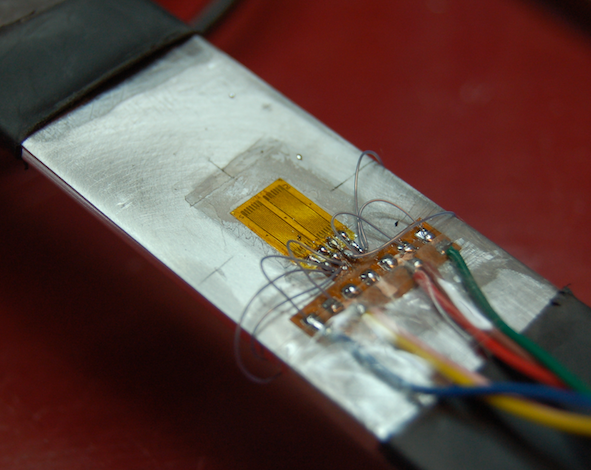
An electronic gyroscope
Enlarge
An electronic gyroscope
Video
gyro.AVI (https://borges/idmil-resources/sensors/gyroscope/movies/gyro.AVI)
Circuits
gyroscope.eps
gyro1.CKT

External links & references


Sensors Interfaces Communications Tutorials References