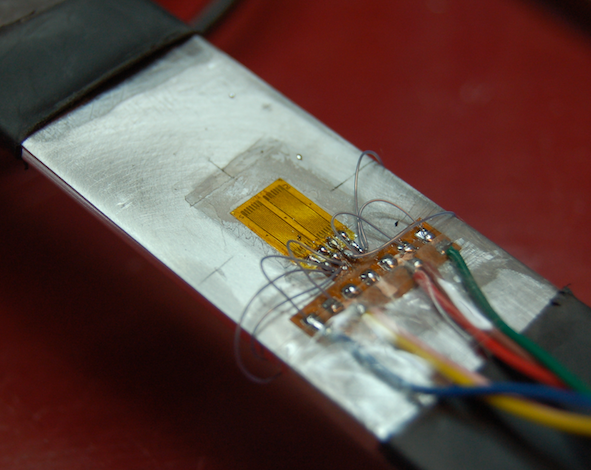
Strain gauge
From SensorWiki
| Sensors | Interfaces | Communications | Tutorials | References |
|
Summary
Introduction
A strain gauge (alternatively: strain gage) provides an extremely simple and accurate way to measure even slight deformation of a solid surface or object. It is a relatively simple transducer that varies slightly in resistance when compressed or stretched, and can be bonded (using adhesive such as epoxy) to metal, plastic, wood, glass or other solids. The most common gauges measure strain only in one direction, but commercial gauges containing more than one sensor on a substrate, arranged to measure strain in different axes, are available.
Strain gauges are classified by:
- Material (usually bonded wire, metal foil, or semiconductor)
- Physical size
- Resistance
- Gauge factor (defined as the ratio of the fractional change in resistance over the fractional change in length along the gauge axis).
Due to their extremely small solder tabs, smaller gauges can be very challenging to attach to leads, though the gauges themselves are helpfully very heat-resistant (industrial applications often use heat-curing epoxy adhesives to attach the sensors). As the output voltage changes are so small, it is recommended that sheilded cable be used for leads to reduce noise. Temperature changes are also a potential source of error, as the resistance of the gauges will change. "Temperature compensated strain gauges" are available, but must be matched to the thermal expansion coefficient of the material to which they will be bonded; alternatively, a 1/2 or full Wheatstone bridge circuit (using "dummy gauges") can cancel error caused by temperature changes.
Strain gauges differ from flexion sensors in that they are constructed from metal wire or foil rather than conductive inks. The wire or foil is constructed in a tightly-spaced grid attached to a non-conductive backing, which must be bonded (using epoxy adhesive) to the object to be measured. When the gauge is stretched or compressed, it changes in resistance due to minute changes in the cross-sectional area of the wire or foil. Strain gauges are much more sensitive than bend sensors, but with a correspondingly smaller change in resistance.
Signal conditioning
Strain gauges are often used in half- or full-Wheatstone bridge configurations, as this increases the output voltage swing and, provided that the bridge arms remain at the same temperature, eliminates error due to temperature change. Also, in order to obtain useful data, the signal is usually amplified considerably. An instrumentation amplifier such as the Texas Instruments INA128, or an instrumentation amplifier circuit, can easily amplify the signal sufficiently.
Other Applications
Strain gauges are also used in the construction of commercial load cell and air pressure sensors. Yokono and Hashimoto [SMC'98] used strain gauges for center of gravity sensing in a load cell–like application.
Devices
Source Country Price Omega (http://www.omega.com) USA US$ 4.50
[edit]Omega SG-3/350-LY41
Encapsulated Uniaxial Strain Gauge with Solder Pads (grid: 3.8 x 2.0 mm)
Variants:
- Omega SG-2/350-LY41 (grid: 2.0 x 2.5 mm)
- Omega SG-7/350-LY41 (grid: 7.0 x 3.5 mm)
- Omega SG-13/350-LY41 (grid: 12.5 x 5 mm)
Datasheet: Omega Strain Gages Specifications Chart (pdf) (http://www.omega.com/toc_asp/frameset.html?book=Pressure&file=STRAIN_GAGES), page 3
Resources:
Notes: Very small and difficult to solder!
Source Country Price Intertechnology Inc. (http://www.intertechnology.com/) Canada
[edit]Vishay/Micro Measurements 375UW
General-purpose CEA-Series gage. Exposed solder tab area 0.10 x 0.07 in (2.5 x 1.8 mm).
Variants: Many different sizes and varieties.
Datasheet:
Resources: Interactive Guide to Strain Gage Technology (http://www.vishay.com/brands/measurements_group/guide/index.htm)
Notes:
Media
|
|
|
|
References
- Wikipedia: Strain_gauge
- Omega Strain Gages Specifications Chart (pdf) (http://www.omega.com/toc_asp/frameset.html?book=Pressure&file=STRAIN_GAGES)
- Online Omega Transaction about Strain Gage (http://www.omega.com/literature/transactions/volume3/strain.html)
- Omega Engineering, Inc. (2000). The Pressure Strain and Force Handbook. 2nd ed. Stamford: Omega Engineering Inc.
| Sensors | Interfaces | Communications | Tutorials | References |